Spiritual Village Latest Posts

Search Spiritual Village & The World Wide Web

Custom Search
Showing posts with label Global Spiritual Movement. Show all posts

Wednesday, July 30, 2008

The Crop Circle Phenomenon

By Ray Bilger

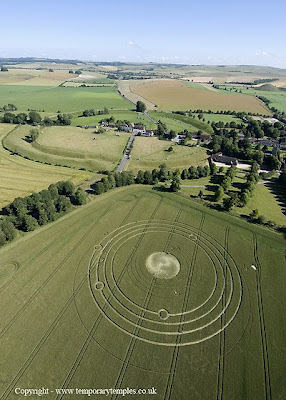
Image Peter Sorensen Copyright 2008

Crop circles are unexplained patterns that are found primarily in wheat fields in England, although they are found in many other places around the world, and in other grain fields. But 90% of the now 9,000 sightings are from England. Their sudden appearance may go unreported unless spotted by someone in an airplane or someone familiar with them. Numerous websites can show you photos of them, such as www.cropcircleconnector.com.

The phenomenon was first reported in modern times in 1972 when Arthur Shuttlewood and Bryce Bond were sitting on the slope of Star Hill near Warminster, England trying to catch a glimpse of the strange unidentified flying craft that had made this part of England a UFO Mecca for almost a decade. But what they saw was something even more extraordinary. Only a hundred feet from them they saw an imprint take shape in a field of wheat—and a large circular area of plants collapsed within twenty seconds.

Crop circle formations are often accompanied by sightings of unusual lights and unidentified craft beaming shafts of light onto a field. Most formations are created at night between 11 p.m. and 4 a.m.

Then in the early 1990s, two elderly gentlemen, Doug and Dave, stepped forward and proclaimed that they had hoaxed all the circles and fooled the world. All they had used was a couple of planks, some string, and a baseball cap. The mystery was solved. But it soon became apparent that they would have had to be in hundreds of places at the same time. The men were interviewed by Colin Andrews of Circles Phenomenon Research International who asked them how they did this one (pointing to a complex pattern they claimed they had done). After a few moments they said, "We didn't do that one." The interview went downhill from there.

It has since been discovered that the Doug and Dave story originated from the British Ministry Of Defense, in collusion with the C.I.A. Evidence supplied by a high-ranking informant in the M.O.D. proves the government intended to discredit the phenomenon to quell the growing public interest in crop circles. (see www.strayreality.com/Lanis_Strayreality/crop_circle_mysteries.htm)

The problem with hoaxing is that it requires a physical object to flatten the crop to the ground, thereby breaking the plant stems. In genuine formations the stems are not broken, but bent, about an inch off the ground, where they re-harden into their new permanent bent position without damaging the plants in any way. Plant biologists are baffled by this phenomenon. When examined by experts, the plants show that the cells have actually been altered, hence, it is scientifically possible to separate genuine crop circles from manmade ones.

On July 7, 1996, pilot Rod Taylor was flying with a passenger in his Cessna near Stonehenge. It was 5:00 p.m., and nothing unusual was seen at 500 feet above the area. Forty-five minutes later the passenger was now driving his car back past Stonehenge and noticed that cars had stopped and people were getting out to look at something spectacular in a field. There in the field was a crop circle of complex mathematical design, 900 feet long, with 149 circles. A Royal Air Force pilot flew over the area only fifteen minutes earlier looking for crop circles, but had seen none. The elaborate formation was made in less than fifteen minutes (and probably in less than one). It took a team of 11 people over 5 hours just to survey the formation.

Suzanne Taylor, Executive Producer of Crop Circles: Quest for Truth, says, "The most unusual thing happening on Earth has not been taken seriously… The phenomenon is a function of processes we can't perform, done by intelligences with design capacities that exceed virtually all people's talents… What is the meaning of the crop circle phenomenon? Another intelligence is making contact. That's all we know for sure… We are being visited and signaled. There is no debate about this among those who are paying attention to what is going on. That there is so little recognition of the fact that this is happening is as astonishing as the very existence of these art works that are executed from another dimension."

John Michell, author and specialist in sacred geometry said, "A great power has arisen, directing our thoughts and perceptions in a certain direction, towards a more complete and satisfactory view of reality than the modern conventions of materialism have previously allowed. Gently, subtly, with no disturbance or panic, we are being guided across a watershed, from one world view to another. And this is in no way arbitrary, but a purposeful process, in accordance with the interests of Eternal Nature and the necessities of the present. We can now see something of what the ancients meant when they spoke of revelation."

The reason I have now brought this whole subject to the fore is because of something I just learned. On July 15, 2008, a new crop circle was discovered at Avebury Manor, near Stonehenge (see www.cropcircleconnector.com/2008/aveburymanor/aveburymanor2008a.html). The new formation shows our Solar System, with the Sun and planets in specific positions. But it is not their positions today, it is the positions they will be in on Dec. 21, 2012, the end date of the Mayan Calendar, discussed in my book. Very interesting. If I find more info about this, there will be a Part II.

Belief in God Drops Among Educated, But 'Universal Spirit' Prevails

By Elizabeth Tenety
In Medill Reports Washington

At first glance, a study from Gallup released Monday seems a victory for atheists: Belief in God declines as education increases. Yet something more nuanced is taking place in academia because while belief in God declines, belief in a ‘universal spirit’ increases significantly during college.

Among Americans with a high school diploma or less, 88 percent believe in God, 8 percent believe in a “universal spirit or higher power” and 5 percent say they do not believe in either. For college graduates, belief in God is at 73 percent, but another 20 percent believe in a ‘universal spirit’ and only 6 percent say they do not believe in either.

The Gallup telephone survey of 1,017 American adults between May 8 and May 11 confirms the findings of a six-year study conducted at UCLA on spirituality in higher education released earlier this year. It found that while participation in religious services declines from 44 to 25 percent between students’ freshman and junior years, students also report nearly a 10 percent increase in “integrating spirituality” into their lives between those two years.

Charlotte Jones Carroll has served since 2001 at American University in Washington as a lay chaplain for the Unitarian Universalist church, a religion that she says “encourages seeking.”

“I think that college is a period of life where you’re seeking many things in the process of maturing,” Carroll said. “I think that having a sense that there’s something larger than ourselves but not necessarily wanting to be tied up to a particular set of rites and rituals is a very logical stage in one’s general intellectual seeking.”

Carroll said she is not surprised that college students explore spirituality rather than atheism.

“Well what does atheism have to offer? It’s by definition a zero. So if you’re curious, why wouldn’t you look into anything you could look into before you settled on the most negative one?"

Patrick Reilly, president of the Cardinal Newman Society, a Catholic organization that works to strengthen the religious identity of Catholic colleges and universities in the United States, is among those not thrilled with the move away from traditional religion.

“We’re losing so much of the great thought and theology that has developed over centuries” when society emphasizes spirituality without the grounding of religion, Reilly said.

Reilly said two forces impact the religiosity of young adults. “In American society, we’ve relied much less on religious education so fewer young people and young adults are getting education in a particular faith.” Reilly added: “The education they are receiving at all levels is much more secularized than what was traditionally provided. Young people continue to have a sense of the divine but very little by way of religious formation.”

But Reilly said the survey did show that, “despite the increasing secularization of American culture,” Americans generally still recognize a higher power, which shows a tendency toward recognizing there is a God.

Sunday, July 27, 2008

Rainbow Goddesses

An original article written by Padma Menon.


The Goddesses met for the second time.

Our first task was to choose a name. There were a few names and it was unanimously decided as Rainbow Goddesses.

Goddesses.

Yes, that is what we are and that is what we will always be. We intend to radiate and spread all the magnificent hues of the rainbow without fear of favour. So there we are, the Rainbow Goddesses have evolved just waiting to spread love, kindness and peace wherever we breathe.

We had prepared a daily Journal to help all of us in the evolution. The Journal was distributed. All the ten aspects/portions were explained and discussed. This Journal is for a 40 day period. A few copies are available still from Khoracle.

Why we chose 40 days? As it was explained to the ladies, 40 seem to have a mystical air. Prophet Muhammad fasted for 40 days in the desert, so did Jesus and Mosses. All of them seemed to have had a discourse with the Divine for 40 days. Many fasts, observance, abstinence in many religious practices are for the duration of 40 days.

It is our sincere hope that all of us will be better individuals i.e. more forgiving, understanding, loving, thoughtful, competent and happier with our lives, living it to the brim with a perfect health and mindset with the completion of the Journal.

There were 5 new members and all of them were welcomed to the group. On retrospect, I am just wondering if we should have an initiation ceremony. Perhaps by forming an arch to represent the rainbow and all new members to walk through it. Who knows with the many talented Goddesses, someone could come up with a song? This is food for thought.

Once everyone was sure how to handle the Journal and were familiar with the contents we watched a slide show entitled “Who I am makes a difference.” The show was on how to honour a person by presenting him/her with a blue ribbon and saying “Who you are makes a difference.” Very often we fail to tell our loved ones this phrase. In this story, the son feels very dejected, useless and not loved; so he decides to take his life. That night the father comes home with the blue ribbon and presents it to the son. He tells his son that he is a great kid and that he is sorry that he had not paid much attention to him except for finding faults and telling him he was messy etc. He also tells him he loved him dearly and he was the most important person in his life besides his mother. The boy breaks down and is sorry. So is the father.

The slide show turned many eyes misty. What we had to learn was each individual is important and who we are does make a difference. So start practicing of taking every opportunity to deliver this strong message.

We had a short break with plenty of goodies brought by the ladies. I must say when it comes to bonding there is no greater bond than amongst the fairer sex and especially with the Rainbow Goddesses.

We moved on to expressing ourselves on how we had faired since the first rendezvous. Generally all of us felt we have to identify the need within us and move away from the blaming game and the habit. We should pause to think how often if anything goes wrong we quickly blame it on the others. If our child has a bad habit it his/her friends are not good, they are a bad influence”. Same reasoning goes for husbands it is always “they” who are causing the problem, they who are cultivating the bad habits they who are the bad influence; if there is a problem between the husband and wife, we will always blame the husband. We should stop this and look at things as a third person, try not to justify ourselves. This is definitely difficult but this habit can be cultivated with a concerted effort.

We should pay attention to the band of vocabulary we use when it comes to expressing our feelings. Most of the time, it is “sad/happy/lousy/terrible/so lost.” Can’t we bring in other feelings like excitement, expectations, clarifications, concern, apprehension, consolidation? We definitely need to look at this feeling at such times and not just focus on the emotional aspect. We must become aware and teach ourselves this technique of self enhancement.

One of the participants confessed that these days. i.e. after coming for the first Goddesses meet, she is able to control her anger better She works in her own company and very often she was irritated and agitated as her staff seldom completed their task on time. Since coming for the first meet, she made a concerted effort to put love first. She now realizes there are more to life than just work, money and achievement. She is less authoritative, speaks more kindly and lovingly to the staff and seeks their cooperation for anything she does. They are all friends now; no one is treated as a subordinate. She is more open, has more compassion and finds herself better mannered. She had never done this before; there is now a complete 360o change. Isn’t this a feather in the cap for the Rainbow Goddesses? Thank you, thank you, thank you Divine Universe.

I feel the Divine Energy is definitely with us and wants us to reach out to all Goddesses so as to awaken the feminine energy in each one of us. Many women have forgotten to connect to this feminine energy.

Coming back to our Goddesses. Look at the complete change in her dear ones. She had realized all of us were equal, there was no boss/subordinate demarcation, and it was no use being authoritative as nothing gets done then. She had become polite and worked with love. The simple four letter word had changed her world.

What would you expect in such a scenario? I think love, peace and joy would be oozing out of every pore. We are overjoyed to hear this mammoth achievement. Wait, wait she had not finished she has gone into meditation and she now has this phrase running in her mind all the time “put love first.” She finds more things are done easily and smoothly, business is better so is the environment at home and in the office.

At the end of the day, all everyone needs is a little love, kindness and the need to be wanted or acknowledged. Such simple and easy ingredients to make the cake of your life.

Another Goddess said she had never attended anything like this before. She was very positive the daily Journal is going to help her look at herself more openly and was sure people were going to change after seeing the change in her. Most Goddesses were very enthusiastic of the Journal; they felt they had something concrete to do daily. They felt they had the tools to recognize themselves and to move forward. We all agreed that we had to first heal ourselves and love ourselves before commenting on or blaming others.

Another Goddess felt the first article was very enlightening and made her realize the tremendous power of being “myself.” She is now working on bringing out the female energy and cutting down on the male energy in her. Before this, she was reluctant to dress up, felt there was no time as she was so bogged down with her work. After becoming a Rainbow Goddess and reading the article, it dawned on her that this was not what life was all about; she had to look hard and deep into herself. She started dressing more femininely, colored her hair and told herself she was in power. She felt and realized everything was within her. She kept telling herself “This is what I am. This is what I am learning and I am changing.” There is a complete switch in her and she is so grateful for this. Doesn’t it feel good to hear all these heart warming remarks? We are paving accomplishments into our lives. Good for you, Rainbow Goddesses!

Another felt her life had been a bumpy ride until the forum. The forum awakened her from a lot of things imprinted in her. She realized the true essence of intangible violence, the value of self respect and integrity in depth. She stood firmly in her believes and left her job. The wrestle between her and the soul came to an end. She faced reality - that was she was not true to herself and had no freedom. Whilst at work she has to follow company rules. She asked herself where the freedom was. This is what her soul wanted – free to do what she wants. She looked hard at herself and felt she had no power, she had sold her soul and in return what did she achieved was fear, insecurity, and confusion. She took stock of herself and the situation. The end result was, she needed to move on and she stood in a space of total surrender. What did she experience? A deep sense of purpose in life. She then moved on to reclaim her presence and power. She transformed from a caterpillar wrapped in a cocoon of fear, insecurity and confusion into a colourful, vibrant, free butterfly. Just, (re)born free. She said she is blessed to be in this space with the Rainbow Goddesses and is so grateful.

There are four points we must be aware of:

a) Blaming others
b) Blaming ourselves
c) We have to sense the feeling at that time of the issue, was it fear, guilt etc. Once we are able to pin point the feeling we must address it. Then we look at the need. Why did e do this?? What was the need? Was it for assurance for us or for clarification of the situation?
d) Similarly we have to do the same thing for the other person involved by sensing his/her feeling and need. If the feeling was anger, why was he angry? Was it because his privacy was encroached upon? What was his/her need- attention, assurance of privacy? Thus if at all times we stop and get a clarification of the feeling of yourself and the other person and then you care to find the need in that situation and stop blaming anyone inclusive of yourself; there will be no drama or havoc to take place.

Another major problem with many of us is we do not know how to relax. How many of us have really watched nature? Can you identify the difference in the chirping of birds or their different calls? Can you identify the sound of a squirrel? Ever heard the rain? Doing any of this is a sure way to relax. Not only that you will find joy and a calmness enveloping you. When we are happy, we vibrate at a higher level. Most of the time we operate from our lower chakras, we need to move to the higher chakra levels to be at peace with ourselves.

We were taught an easy way to achieve this by using the violet flame. All you have to do is imagine a violet flame, then immerse yourself in it; see yourself burning and allow the flame to go through all the seven chakras (a chakra chart is attached with the journals). Then you imagine a Golden Light coming from the sun; allow this golden light to flood your heart and then rest there. Next imagine yourself going through the physical, ethereal and spiritual levels. This little exercise will bring you peace and love. You become a constant supplier of peace and love.

When you are in peace and love, you definitely vibrate at a higher level. In this way you are also doing well for Mother Earth. If things do not work out just surrender and heal. Remember when we are whole and perfect, no issue or situation is impossible to be solved or settled. Move from one issue to another; work on all issues until there is none. Remember issues only help us to grow and gain experience. Only when there are no issues you become whole and perfect.

All of us have the Goddess within us. All we have to do is take steps to awaken her and listen to her and ask her to guide us in our daily lives. Start each day with a short prayer to her asking her to guide and lead us and to allow us to do her work daily.

Thus ended our second meet, for the next meet we will dwell deeply on affirmations, goal setting in and for our lives.

We ended with a short meditation. Many of us felt Mother Earth was with us, she blessed us with a symbol.

Till we meet again
Peace love and light

-----------------------------

Padma Menon does Angel-Card Reading at Khoracle, Malaysia on every Tuesday and Wednesday. During the reading, you will be clearly shown the light at the end of the tunnel. And you will be provided with clear steps on the action that you need to take. Anticipation is better than ignorance. Call the Khorcale at +603 80606970 or +6012 910 5812 for a booking.

See Older Original Articles by Padma Menon

Goddesses Only

See Related Articles on Padma Menon

Reiki for Animals: A Padma Menon Story
Channeling? A New Age Fad or An Ancient Practice?

Friday, July 25, 2008

Spirituality Vs Religion: Different Beliefs?

By Catherine Zeeb
In Vail Daily

We hear and read the term “spirituality” or “spiritual” everywhere these days. What does this truly mean? Are those who call themselves “spiritual,” religious, and vice versa?

Wikipedia defines spirituality as “concerns with matters of the spirit, a concept tied to religious belief and faith, a transcendent reality. Spiritual matters are thus those matters regarding humankind’s ultimate nature and purpose, not only as material biological organisms, but as beings with unique relationship to that which is perceived to be beyond both time and the material world.”

Religion is defined as “a set of beliefs and practices, often centered upon specific supernatural and moral claims about reality, the cosmos, and human nature, and often codified as prayer, ritual, or religious law. Religion also encompasses ancestral or cultural traditions, writings, history, and mythology, as well as personal faith and religious experience. The term ‘religion’ refers to both the personal practices related to communal faith and to group rituals and communication stemming from shared conviction.”

Those who believe they are spiritual but not religious are still seeking their connection to all that is greater than themselves. Those who believe themselves to be religious are doing the same. Spirituality allows for exploration of all possibilities with no boundaries. Religion usually discourages exploration and defines the boundaries. Neither is right or wrong.

Spirituality encompasses the whole soul’s journey. It explores that which is immortal within you. It connects the metaphysical reality that is greater than oneself, which may include an emotional experience of religious awe. Spirituality is concerned with matters of psychological health and to activate the higher potential of the human being. One working in a spiritual practice seeks to become free of the ego and more in tune to one’s true self.

Spirituality asks you to explore and believe in the vastness of the answers. People who are spiritual may or may not use the words of religious writings such as God, Jesus, etc. They may find these words too confining in a world of exploration. This does not indicate that they don’t believe in God, Jesus, etc.; the words do not define their beliefs.

Religion is often described as a belief system of thought, unseen being, person or object that is considered to be supernatural, sacred, divine or of the highest truth. Religion generally refers to organized gatherings, a coming together of communal beliefs. It defines morals, practices, values, institutions, traditions, rituals, core beliefs and scriptures. It is defined as a “way of life.”

Religion asks you to believe in the written word and doctrine, to follow the path or way. People who are religious may or may not use words of spiritual writings such as intuition, other realms, etc. Since these words do not have a definite answer, people of religious beliefs may find the words of a spiritual practice to be too undefined.

These two beautiful and complimentary practices allow us to blend our questions of the unknown into a practice of belief. Spirituality is about being open, exploring and learning to ask questions. Religion is about understanding the provided (written) answers to our questions. Neither is right or wrong. It is about personal choice.

Wars are fought over who’s right and who’s wrong when it comes to religious beliefs. Enjoy who you are and enjoy your search for answers to the unknown, however you choose to do it. Being spiritual or religious doesn’t matter. The fact that you’re studying or examining something to connect to is more important than doing nothing.

See Related Article:

Saturday, July 12, 2008

What Do Cross Tattoo Designs Symbolise?

By James Woolley on July 11
In Best Syndication

Cross tattoos are a very popular type of tattoo design with both men and women nowadays. They convey a very strong message and have great meaning to the person who wears the tattoo. So what are the different types of cross tattoo and what do they represent?

Well cross tattoos are mainly associated with religion, as you might expect, and are very closely associated with the Christian religion in particular. Many Christians are deeply proud and passionate about their religion and a cross tattoo for many is the perfect way to convey their strong belief in the Christian religion, and their love and respect for Jesus Christ and God because the Christian cross symbolises Jesus Christ returning from the dead.

There are various different types of Christian cross. There is the basic latin cross which just consists of two intersecting lines, then there is the crucifix which depicts Jesus Christ on a wooden cross. In addition other variations of the Christian cross include ones covered in thorns or nails.

Away from the traditional Christian cross, you've got the very popular Celtic cross. This tattoo design combines the latin cross with a circle to create an attractive looking design. These tattoos are also very popular with Christians but are also very popular with many people who have deep Celtic connections in their family history, as they are a great way to honour their Celtic heritage.

Another form of cross tattoo and one that is growing in popularity is the memorial cross. Memorial cross tattoos are very popular with those people who have lost loved ones and want to have a permanent memorial of them with them at all times. Made in the shape of a gravestone, these tattoos are very poignant and deeply moving, and with suitable words added to the tattoo are an excellent way to remember those who have sadly passed away.

Finally the other common type of cross tattoo is the Gothic cross. Goth people are not necessarily religious people but they do still like to use religious imagery in their tattoo designs. These designs are German in style and are often deep-set tattoos that consist of a cross together with barbed wire and daggers.

So overall there are many different types of cross tattoo available. These tattoos have always been popular, and will probably remain so in the future, largely due to their powerful symbolism and striking imagery. They have deep religious meaning but they also convey a respect of spirituality for non-religious people so cross tattoos are a very versatile type of tattoo design.

Saturday, July 5, 2008

Launching a Spiritual War on Global Warming

By Douglas Todd
In Vancouver Sun

An approach that provides the inner strength to tackle the worst effects of the changing climate patterns

Does global warming pose a spiritual problem? Those who do not believe in any form of divinity would probably say No.

And even some who believe in a transcendent reality might think global warming basically needs to be fought through political, scientific and economic means.

But perhaps a spiritual response is also needed to global warming -- to provide the inner strength necessary to face and combat the worst effects that are to come from the Earth's erratically changing climate. You don't have to go to a church, synagogue or temple to be "spiritual" (although it doesn't often hurt). Spirituality can be broadly defined as the attempt to respond meaningfully to life's existential challenges.

And if you believe last year's Nobel Peace Prize co-winners -- Al Gore and the United Nations Intergovernmental Panel on Climate Change -- the greenhouse gas buildup caused by fossil fuels is definitely one of those existential predicaments.

Those who feel they don't have to do anything about global warming, or are in denial, might have to draw on some deeper resources, including transcendent ones, to help them face the difficult music.

And for those who have accepted scientific arguments the world is growing hotter at the fastest rate in recorded history as a result of human actions, a spiritual stand could help overcome a sense of helplessness and despair.

A spiritual response would also include accepting the western world's contribution to environmental disruption -- and not just pointing the finger of blame; scapegoating, say, China, for turning into the planet's newest, biggest reckless polluter.

Spiritual wisdom can also be helpful for those who are just old-fashioned afraid.

They've heard the warnings that global warming could lead to themselves, or more likely their children and grandchildren, struggling in a dystopia of global conflict over depleted natural resources. They need help being brave.

I have been re-convinced of the necessity of a spiritual response to environmental problems by the powerful just-released book, A New Climate for Theology: God, the World and Global Warming (Fortress), by B.C.'s Sallie McFague.

"Climate change will demand much of us," writes McFague, who had a prominent career at Vanderbilt Divinity School in Tennessee before coming in 2000 to the Vancouver School of Theology on the UBC campus, where she is considered by many the globe's most important eco-theologian. At a time when Canadians, especially British Columbians, are debating the pros and cons of a new carbon tax, McFague shows she's entirely up to speed on the science of global warming.

She also believes climate change is a more clear and present danger to the globe than Naziism was prior to the Second World War. As such, she picks up an idea philosopher William James would have been suggesting back in 1906 when he wrote his famous essay, The Moral Equivalent of War. It maintained citizens need to muster the dedication, sacrifice and virtue brought to launching a military campaign to fighting peaceful causes, in this case saving the eco-system.

McFague believes we need to adopt a radical war footing against the common enemy of global warming, whose insidious consequences she first noticed 20 years ago while hiking in the Rockies -- in the decline of once-magnificent glaciers.

McFague makes it clear that vigorous legislation, which sets limits on consumption and emphasizes communitarian values over individualistic ones, is necessary to combat global warming.

Citizens are invited to reflect on such values as they weigh the current B.C. Liberal government method of tackling global warming through a "revenue-neutral" surcharge to all fuels, or the provincial NDP or Danish approach, which lean to targeting industrial polluters while financially encouraging energy-saving innovation. Even though McFague understands politics and especially the science of global warming, the unique contribution of her book to the debate is theological and philosophical.

In making her case, McFague recognizes in a postmodern world influenced by the "deconstructive" philosophy of Jacques Derrida (in which the word "God" is virtually forbidden) she must offer what she calls a "minimalist theology." It should be acceptable to virtually all.

Her stripped-down theology centres on feeling gratitude for the planet and a sense of interconnectedness with all creatures.

A New Climate for Theology does not define spiritual "salvation" as select individuals obtaining eternal life, but rather, as the early theologian Iraneus put it, "The glory of God is every creature fully alive."

Convinced the flourishing of all living things should be our ultimate spiritual goal, McFague offers an understanding of God that might seem novel to many.

Even though McFague is a Christian, she says she goes beyond "neo-classical" western theology to "evolutionary" theology.

God is not a "being," she says. Instead, God is the source of life, love and hope.

She sets out a mystical vision of the universe as God's beloved body, even suggesting we all metaphorically exist within "God's womb." And even though humans are beginning to destroy the tiny portion of God's body that is Earth, she maintains the divine is always ready to work with humans to redeem this planet.

Echoing e.e. cummings in the poem above, A New Climate for Theology spells out a spiritual attitude of gratitude and praise toward the natural world, upon which she emphasizes we all rely.

It's a sense of thankfulness available not only to the explicitly spiritual, but also to a "secular" gardener who simply marvels at the rite of growing flowers and vegetables.

Fighting a spiritual war against global warming will demand that we live differently, McFague says. But our motivation for coming together in the military-like campaign should not be fear, or even duty.

It can be gratitude and love.

"We stand with our feet firmly on the earth," she writes, "and exclaim, 'I thank you god for most this amazing day.' And then we get to work."

Tuesday, July 1, 2008

Peace Movements In Nepal

By Dev Raj Dahal, Head, Friedrich Ebert Stiftung-Nepal
In Telegraph Nepal

Introduction

Once members of a society become fully aware of certain common interests and common values building community of peace can become possible, unconsciousness about these common elements makes conflict unavoidable. This new consciousness is the central feature of many fields of study in the sciences, social sciences and religions—the three basic sources of human knowledge—as each of the branches expresses various intellectual perspectives on the world. Social scientists are carefully struggling to liberate the rule of power, interest and ideology in knowledge. Based on the assumptions about human nature, the nature of state and international system, they have constructed various approaches to grasp the role of science and technology in resolving the problems of human societies. Today, the increasing fragmentation of sciences and social sciences into several disciplines has, however, produced mind-numbing specialization and divided their constituencies accordingly beyond the capacity of human beings to imagine, perceive and integrate.

The word religion is derived from Latin, religio, which means, "to re-link" or to re-connect people of various social, economic and geographical origins into a normative framework for socialization and norm-based action. Building a community requires not only the application of “reason” which is the sovereign domain of science and social science but also feeling, emotion and normative bonding derived from the spirituality of humanity and religion. It is only the philosophy of religion that is trying to establish the bonding of human beings through faith and feeling. Religion is a moral substratum of human life. "For religion is a major factor of peace and war—depending on whether the re-linking vision encompasses all or against somebody" (Galtung, 1995:64). Realists are oriented more toward order than law, morality and peace. The idealists are the community builders because they see the importance of shared values, institutions and practices for a peaceful life. The central reflection of the spiritual awareness is to develop an "oneness with all, a sense of belonging to the universe as a whole" (Capra, 2002:59). Noted scientist Albert Einstein resolves the dilemma between science and religion in this way: "science without religion is lame, religion without science is blind" (1979:46). Knowledge about the whole and one's own place in it provides one to systemic orientation.

Religion is close to the idealism of peace rather than realism of power because it rests on the confluence of civilizations rather than a balance of power. Idealists believe that balance of power among nations cannot help to achieve world peace whereby world community can escape from perpetual anarchy of free wills that characterizes today’s international system. Neither imperial (domination of people and nation-states), nor hegemonic (partitioning the world into sphere of influence or divide and rule) nor even muscular (eliminating opponents and suppressing the dissenting voice) peace can ensure a wider system of mutual security. Only a democratic peace based on participatory structures can satisfy the needs of diverse societies and resolve their conflict non-violently. The first task of social science, like religion, is to liberate human being from the state of nature by creating community capable of subduing chaos and constructing public order; the second task is to negotiate a social contract that puts moral and constitutional checks on the holders of power; and the third is to establish a condition to balance freedom with public order and justice for the peaceful life of people. These conditions are important at a time when international system has not undergone a true transformation away from anarchy but reflecting historical patterns analyzed by realist school of social science. The power of reason espoused by social science has its own limitations. The great Enlightened Philosopher Emmanual Kant in his "Critique of Pure Reason" shows that "human knowledge is constrained not merely by the unlimited magnitude of reality but also by a sensory apparatus of perception" (D' Souza, 2007).

Peace politics largely counters four institutional sources of violence—the hegemony of reductionist disciplinary knowledge and perspective derived from single subject such as economics, political science, sociology, history, theology, geography, etc; disciplinary order built on rigidly institutionalized social division of labor based on caste, class and gender; the constitution and institutions not conforming to the aspiration of people for freedom, human rights, social justice and peace; and disciplinary politics incapable of fulfilling basic needs and representing social diversity into political power thereby provoking multiple opposition, resistance and rebellion and stoking perpetual fear among people. The counter-narrative posed by idealists hopes to ameliorate the instinct inherent in animus dominandi, through laws, peace and institutions.

Cosmology of Peace in Nepal

Peace education and peace movements are very old themes in Nepal. Since the dawn of human civilization, ancient sages and philosophers had consistently brought to life the interconnectedness of all life like modern system theorists of science. They opposed the multi-dimensionality of violence and war and yearned for peace based on social justice. Hindu religion evolved over 3,000 years ago talks about shanty (peace), which is regarded as a common good. Vedanta was later developed into Brahminism in which the philosophy of Upanishads was expounded. Vedanta philosophy consists of three cardinal principles:
a) human beings’ real nature is divine and not like what Thomas Hobbes described as hasty, nasty and brutish to be disciplined only by an all powerful Leviathan;
b) the aim of human life is to realize this divine nature through enlightenment and overcome the fatal mixing of realism and violence; and
c) the essence of all religions is the same and they are intrinsically rooted in harmony as they seek cooperative human potentialities for peace. As a result, they avoided the clash of civilization. All great religions favor austere life-styles "marked by a series of renunciation, interdictions and prohibitions (Foucault, 2001:361).
The meaning of Veda and Buddha is enlightenment--self-realization, nirvana and awakening. It also denotes the condition of human happiness arising out of the absolute cessation of desire, renunciation and the development of some conception of a sanatan dharma, higher law than the projection of greed, grievances and self-interest. The Hindu treatises Ramanayan, Mahabharat and Bhagbad Geeta, like Bible, have defined the code of conduct for a just war to eliminate the root causes of evils in society. To both religions, war can be justifiable for only higher level of ends. The Hindu religion offered poly-theistically inclined worldviews and accepted others' values and beliefs. Nepalese consciousness is determined by the co-evolution of Hinduism, Buddhism and many local faiths rather than exclusion of one at the cost of other. Like Christianity, both accept the culture of kshama (forgiveness), empathy and compassion for the reconciliation of conflict-torn society. "Victim communities and their tormentors need to do much more to transform the past and present into a redemptive future" (Gopin, 2004:124).
Buddhist worldview evolved in the 5th century BC is non-theistic. But, like all religions, it cherishes the highest aspirations for altruistic compassion, humility and enlightenment. Buddhism shares with Hinduism the law of karma (the social theory of cause-effect relationship) and moksha (emancipation) from the cycle of suffering and rebirth. Gautam Buddha’s earlier teachings preserved in Suttas seek to address the problem of universal sorrows through morals, such as charity work, right conduct, meditation and mental training aimed at self-improvement. It is based on transcendental knowledge that frees human beings from their super ego and selfish ends that underlie the root causes of all conflicts. The transcendental knowledge of Immanuel Kant, Georg Hegel and Karl Marx resembles a common theme of emancipation with Asian religions. Like Marxism, the Asian religions talk more about human emancipation than human rights and prefer, like Jacques Derrida, the deconstruction of structural injustice from society for better form of social cooperation. In no way, however, they defended the anomie of secular post-modernism. Hinduism, Buddhism and Confucianism provide lessons on "how religion and governance can be juxtaposed and how belief can inform policy and action" (Carter and Smith, 2004: 286). But, like Christianity, Judaism and Islam, none of these religions defend conversion of faith.

For Hindu, yagna-- a process of achieving knowledge of ultimate reality through reason, distinction between eternal and ephemeral phenomenon and a culture of sacrifice-- is the path to nirvan (enlightenment). The faith in enlightenment fostered a rational contestation of reason and principles to solve the existing problem of society, build moral leadership and promote inter-faith dialogue. The Hindu-Buddhist treatises are concerned not only with the ends of politics but also the means and lay down the theory of karma—a law of causation, which operates at physical, mental and moral spheres of human beings and transcends several generations. Those who perform virtuous karma (conduct) receive good result independent of one’s own wish and desire while bad conduct yields vicious results, dukha (suffering) and conflict thus producing a source of bad conscience.

The Hindhu-Buddhist dharma-mediated statecraft puts inner moral checks on the rulers’ will to absolute power and makes them conscious about their accountability to the public. Hinduism accepts and tolerates a culture embracing diverse norms, beliefs, cults and practices. It has neither any beginning nor any founder like Christ or Allah, not even any authority figure to impose structure, discipline and punishment. Discursive formation of knowledge is, therefore, very important to evolve consensual code of conduct for diverse society for enlightened coexistence. Hinduism regards all phenomena as imperfect manifestation of one reality.

The Buddhist revolt against karmakand (orthodox Brahmanism) was partially prompted by a generous idealism to rectify the priestly aristocratic bearers of effective social power rather than total negation of Hinduism. It involved the contestation of subjection of people, offered alternative institutional model and underlined the principles of social change. Gautam Buddha spread the consciousness of world brotherhood and attempted to transform dukha (misery and pain) into sukha (bliss and well-being) through structural change, education and right conduct. To him, society is not the divinely ordered nature of things but is a human creation brought into existence by choice and action. Johan Galtung in his “Buddhism: A Quest for Unity and Peace” underlines that the application of Buddhism can help to solve global problems of peace, social development, human enlightenment, nature balance and cultural adequacy. For Buddhist, there is no “higher bliss than peace” (1993: 1-6). The inner peace is the peace of mind, which is related to outer peace where human beings live with their fellow beings in a reasonable harmony with nature and culture akin Rousseau's general will. Social change has to begin with the individual and that only by living in the right way one can achieve self-fulfillment.

Both Hindu-Buddhist religions see individuals in relationship to a higher system. This is the reason they give primacy to a balance or the middle path (Golden Mean) between the greed of individual and the need of human beings, and between individuals’ quest for freedom and system’s imperative for order, stability and coherence for the promotion of collective good. Unlike Hindus, Buddhists oppose war whether it is “righteous” or not and argue that a durable peace can be achieved by only peaceful means. True Buddhists maintain a truly pacifist position, renounce violence as a policy tool to achieve certain objectives and engage in peace education and action. The Buddhist Sangha remained as monastic community based on the principles of peace, tolerance and non-violence like Gurukuls, Guthi, Math and temples as well as several charity organizations of Hindus. They, like Confusians, considered that engagement in education, civic life and toleration of differences are central to the resolution of conflicts. "The cure of souls, is very important, both in protestant and Catholics Churches" (Foucault, 1991:342).

Nepal’s Public Space

Many of Nepal’s traditional civil societies, such as religious organizations and social institutions are duty-based, have had organic formation and advocate ahimsa (non-violence) as a tool for political socialization in gurukuls (residential schools) like Plato’s Academy in Greek city-state. Historically, the shastrarartha (discourse) organized in public places, temples, open theater and public inns was opened to all people. "A portion of the public sphere is constituted in every conversation in which private persons come together to form a public" (Habermas, 2000:288). They aimed to train people not only in scholarship but also in wisdom and right conduct. King Janak encouraged sastrartha (discourse) in his palace aiming to liberate political power from its oppressive content, shape public opinion and reach a shared understanding of the situation in regulating and reproducing forms of cultivated social life. His contemporaries have also stressed on the conduct of dharma (good public action) for value integration among various societies and laid the groundwork of cosmopolitan order akin to Immanuel Kant’s vision of perpetual peace rooted into universal reason, cooperation, humanity and justice. Dharma, however, neither means a religion nor spirituality. It is a duty-based behavior of holders of position and power and absolutely independent of religious doctrine. Sastrartha performed in King Janak’s palace was a rational process of deflating dogmas and reaching mutual understanding and consensus among all the concerned participants, mediation of radical disagreements and application of reason and various perspectives for conflict resolution. Discourse made self-righteousness of leadership difficult and self-criticism quite easy. Like Confucianism, this has facilitated the non-violent resolution of conflict and enabled citizens to become peaceful members of a community.

The Hindu religion puts sanatan dharma (the higher form of cosmological order) above barnashram dharma (social division of labor) and raj dharma (national governance) and articulates the interconnectedness of human life and natural world. Vedic ethics is concerned more about moral conduct of human beings towards each other and nature than with religious problems. Sanatan dharma has always propagated peace and universal brotherhood and generated suitable environment for harmonious co-existence. According to sanatan dharma, a society, which is highly resistant to adaptation and change, is conflict-prone. This means, like Judaism, both Hindu-Buddhist religions propagate the concept of “positive peace” grounded in changing needs of human beings. Judaism suggests that if "peace is to endure, parties must transform themselves—their thinking, their actions and their relationships" (Carter and Smith, 2004:282). Many Hindu treatises including Kautilya's Arthashastra, have defined the reasons of state not only in realpolitik term but also normative values, combined morality with politics and defined mutual rights and obligations of states and people. Gandhism justifies satyagraha (non-violent civil disobedience) against the hegemony of unaccountable power. Both Hinduism and Buddhism claim that the universe is a web—each part is related to the whole aiming to integrate itself into universality. Only recognition to each other’s space and identity makes peaceful coexistence possible. Otherwise, in a state of nature, peace will remain as a tragic symbol for human being. Peace without justice, fairness and equity simply cannot endure. This is the essence of Bhagbad Gita. It allows legitimate opposition, resistance and even rebellion if the foundation of political power is unjust and unaccountable.

Structural Condition of Peace

Conflict becomes inevitable when political order is maintained despite structural injustices, inequality and exclusion and consent of people is sustained by the effective use of force, media manipulation, false consciousness and hegemony. The historical condition of social orthodoxy, gender inequality, conservatism, caste hierarchy of human beings and bureaucratization of society in Nepal has undermined traditional social fabric and social capital and generated a dynamic tension between the civic and un-civic power. The corrupt and patronage-based fundamentals of the regimes of all types— based on nexus to power remained unchanged despite regime change several times which is a barrier to the negotiation of a lasting social contract between the state and society. This tension for the redistribution of resources even linked local power struggle to regional and global geopolitics and scuttled the prospects for democratization, modernization and rationalization of society. This means peace politics is not essentially a static and anti-change (negative peace). It involves the contestation of ideas about good life and renegotiation of political space. In negative peace, political actors are less able to coordinate their actions in the quest of a common good as they are not cohesive enough and each actor tries to maximize its individual gain rather than social utility. And the rationality of action is determined by self-interest rather than morality and the conception of dharma.

The responsibility of policy makers lies in developing a converging policy between the two forces—forces of status quo and forces of radical change and politicize the decision-making for the creation of peaceful society amenable to steady change articulated in Golden Mean. The roles of social scientists lie in unpacking the clustering themes—conflict management, conflict transformation and conflict resolution—and defining the task for each of these components for peace building. The hierarchical social reality of Nepal describes precisely the relationship between people and their space in power dynamics. Nepal's power complex is non-linear, therefore, the process of modernization based on linear progression of development alone cannot settle the interconnected social, economic and political contradictions. The narrow definition of peace espousing anti-war posture, absence of violence or anti-state discourse cannot address societal grievances. Violent mode of resolving political conflict is ultimately self-defeating and unsustainable as it fosters a culture of violence, not the culture of peace. Only a practical rationality governed by a conscious goal of peace is expected to foster harmony.

Contemporary Peace Movements

Have peace movements in Nepal contributed positively to deescalate conflicts? Has the public opinion pro-actively mobilized by peace movement efforts separated politics from violence? Have the peace movements been helpful to moderate the partisan, conflict-prone, power-oriented behavior of leadership? Are political actors looking for an incentive to co-operate with each other and break the cycle of zero-sum game that made Nepal’s politics immobile, opaque, disengaged and deadlocked due to growing pressures from the peace movements? How peace movements can generate enough costs for leadership to cooperate for peaceful conflict transformation?

The contemporary peace movements in Nepal began with the protest against intense human destruction caused by the escalation of CPN (Maoist) People's War, counter-insurgency operations following the growth of a politics of clientalism oriented towards monopoly of resources controlled by the state, insurgency of non-state actors and movement-oriented groups and federations for representation. The perpetuation of conflict in Nepal is attributed to each actor’s claim to the legitimation of power, the defense of one’s own rights, absolutization of particular interests and a refusal to accept common good, common ground and national interests. The Nepalese raj dharma (polity) has been subverted from within by the primacy of loyalty of leadership first to their affno manchhe (primary groups), then to political parties and less to the nation and its citizens. The system of governance has lost its legitimacy due to the inability of political leadership to prevent conflict, economic down turn and social injustices and discover the common ground of reason upon which they all take their position. Against the background of the state’s lack of legitimacy monopoly on power, the political conflict provided a space for manifold social conflicts and broke the political connection of citizens with the state. The Nepalese citizens still have a chance to stand up and stake their claim on peace and justice against their leaders who know no morality of power except competition of self-interest. They failed to learn to communicate among themselves except through media and, consequently, are indulged in perpetual struggle for power lusts devoid of inner moral springs and checks.

Most of peace movements organized by civil society in Nepal have latent consequences as well as manifest, immediate ones as they reacted against escalating factors and highlighted the root causes of conflict. The latent consequences cannot be measured by a specific peace campaign against the use of child soldiers, use of force against non-combatants, ban of landmines, protection of human rights, abuse of women etc. After the signing of Comprehensive Peace Agreement (CPA) between the ruling seven-party alliance and CPN (Maoist) one can measure several peace indicators, such as mode of de-escalation of conflict, change in the behavior of actors, transformation of contexts, issues, goals and identities, defining of common stakes and developing people’s capacity to comprehend facts and issues. National policies have established some of the structures and procedures for resolving conflicts and formulating and implementing rules. These are necessary conditions but by no means sufficient to guarantee the establishment of peaceful legitimate order unless the CPA regulates the behavior of drivers, actors and stakeholders of conflict system through a new social contract through Constituent Assembly. A peace monitoring mechanism must be set up from the independent people. The growing tendency to projectize civil society and human rights institutions and their instrumetalization against the state has de-politicized their capacity for the social emancipation of people and an élan vital for collective action.

In a broader sense, peace movements have the goal of establishing a “positive peace”—a peace that constructs a modicum of legitimate order in society based on social justice and transformation of violent social relationships into non-violent ones. In positive peace, political actors are able to coordinate their actions in quest of common goals, such as human rights, democracy, equity and ecological balance and thwart the efforts of disruptive forces. Similarly, it establishes the compatibility between the ends and means of politics and rationality of action is determined by value-orientation as well as goal orientation underlined in CPA. Contemporary peace movements in Nepal are pluralistic and multi-thematic in nature ranging from inter-faith dialogue to anti-war demonstrations. They flourish with an awareness of interconnectedness and interrelated transformation thereby linking the underlying deep division of society and seeking the peaceful resolution of conflict. A democratic constitution that is broadly respected and keeps the balance between the Spirit of Age and the needs of Nepalese people can only hope to resolve conflict peacefully. Only then personal and inter-personal transformation and democratic legitimacy through the consent of people can help to construct an edifice of order. Enforceable rules and authority relationship are important for maintaining the structural stability of the polity and developing harmony between the state and society. Unity of interests between the two makes peace both realistic and possible.

One key problem in Nepal is that due to often anti-state and pro-market discourse articulated by civil society and human rights, their interest in working for national or broader public interests have been questioned by the public. And due to upholding of particular ideology civil society’s capacity for social integration of subsidiary identities (gender, ethnicity, religious, caste groups) and transforming them into enlightened citizenship have been contested. The immediate reason of the conflict springs from the status quo and delay in necessary reform programs although CPA has aimed at conflict management through social change and cultural, economic, political and social transformation.

The communities for peace in Nepal are too diverse lacking any coordinating mechanism for sustained collective action. Similarly, the multiplicity of actors pursues their interests irrationally. This is preventing the non-violent resolution of conflict. This means inter and intra-party peace building process is required to pursue them for rational behavior in times of crisis. The gaps between civil society actors should also be bridged though consensual means and a rainbow coalition should be created for peace, solidarity and public action. In Nepal, the state has ceded some of its powers to private sectors and civil society in the peace process and the laws provide roles for them in local and national level of conflict resolution. But, political will, skills and ability of civil societies to address the critical social needs of citizens, prevention of violence and creation of an environment for dialogue and compromise have been limited.

The activists of peace movements are politically divided along partisan lines. The approach to peace movements appears top-down that focuses on working within the political system to influence decision makers. There is a need to strengthen and expand local peace committees so that local conflicts rooted in structural injustice are mediated through resolutionary change. An economic cost of militarization of society is not properly highlighted. Peace activists have not forwarded the vision regarding civil society development which is shaping the dynamics of conflict. The triumph of civil society over the state has weakened the common identification of people with nationality and its role as an arbiter of contending interests.

Conclusion

One can agree with Kant that deeply rooted and widely diffused conflict cannot be resolved by either by utilitarian doctrine of politics or its step-mother of socialist discontent but only by the realization of rights by the people (Hastie, 1891:XXXVII). Although awful applications of religions and social science have caused violence and war their original aim was to moderate various forms of extremes in society, resolve differences through norm-governed conduct and shape collective future. They also advocated the de-legitimization of violence as a policy tool to achieve goals. Thinking about the articulation of alternative viewpoints and development of a political culture of tolerance is central to break the chain of power and personality-centric politics devoid of common good. Science can restore the reason to a normal mind while religion has the moral power of consolation and reconciliation.

All conflicts between groups are capable of solution through negotiation and compromise if they are dissolved into a representative framework acceptable to all. Peace can be achieved by changing the root causes of conflicts. Integrated framework of peace building requires the ability of people to generate social capital so that they can face the future with great confidence. And accordingly, "rebuilding what has fallen apart is centrally the process of rebuilding relational spaces that hold things together" (Lederach,2005:75). Since the cause and effect relationships are often irreversible only the elimination of root causes can make a critical dent on the conflict system. Integration of concept between peace education and peace action requires the establishment of joint civil society and NGOs in crisis zone, strengthening the connectors of society, building their capacity and doing activities there including early warning and early response to conflicts seeking a new social order. If religious framework of ethics disappears from the society, the rationalistic and scientific tradition of competition alone would not be able to offer resolution.

Tuesday, June 17, 2008

Aliens, ET, Crop Circles Prior To 2012

By Theresa J. Thurmond Morris
In The American Chronicle

Aliens, extra terrestrials, UFOs, crop circles and 2012; one might ask what all of these words have in common?

The inclusion of these words in one title and one sentence is for a reason. We are learning about our own DNA and how we came to be here on earth. We are considered sentient intelligent beings and are considered the ascension humanoid kind. We sentient intelligent beings of the ascension humanoid kind have much in common with others who are of the sentient intelligent beings species not of this galaxy. Aliens are a word we use to describe those not of this planet's origin.

The ETs are those who are extra-terrestrial beings not of earth origin. UFOs are what we call the alien ET spacecraft. Crop circles are the signs that were left prior to the hoaxes. 2012 is the year that the Mayan calendar ends. December 21,2012 is the date that we all are recognized and recorded as one species on earth by alien ETs intelligent being species.

We are to be aware of our place in this meta-universe. Some need the truth spelled out. Faith in the future of a species is important. Other beings on earth in the past were assisted from time to time and if one desires to recognize the truth, there is truth in patterns left on earth as an exordium.

Many of us believe in aliens, ETs, ascension intelligent beings, and that they are the creators of the real original crop circles. We also believe that the aliens or ETs are ascension intelligent beings and that they are our creators. In other words, they are us. Some times the truth repeats it´s self as do we. The truth will set us free and there are many who are calling for those who know the truth about aliens and their UFOs to share the truth with everyone on earth. All beings should know the truth about the alien Et UFOs and crop circles. But, not all will recognize the truth. Part of being a creative spirit is having faith in that which cannot be seen or experienced in the physical as in existentialism.

There are many of us on earth who relate to those not of this earth. More than the powers that be want to admit to the general global population. There are more of us coming out and finding our voice. There are those who desire to know why we as one species one earth have been kept out of the loop on the knowledge of the aliens and the UFOs that we know exist. We want to know of all the alien civilizations that have come to earth in our past and are our alien ancestors. We have been told some truth in our past history but not all. There are some who still believe in the truth of books that are considered history books and historical documents that have been left behind in caves by others who have lived on earth prior. There are some who have learned parts of the truth and have begun to mix the truth with lies created by prior nations and government world leaders. There are some who have been lead astray by those who thought they were sharing their knowledge of the truth. This is still the way it is on earth. There are some who know only what their minds can allow them to believe as the truth because that is what they were taught to believe by others.

We are they who desire to know as much as we can about our human existence on earth. We desire to know who we are, what we are here to accomplish, when we are leaving, where we are going when we leave earth, and why we exist. Many of us who desire to believe in our own soul's spiritual ascension already know that there is documentation of other beings that have come before and left us information on how to obtain ascension. This was documented in the past on earth. Some may find truth in part of the Holy Bible and the Holy Quran along with other scriptures not in these sacred text books. There are many scriptures that were published as it is said in our past that were not allowed into these books which are treated as holy and sacred scriptures of the world's largest religions. For many beings, science has become a religion. The majority of beings on earth believe in one God and not many gods. One might say that the original beginning was God. Some say in the beginning was the big bang. The truth is these are simply words. Atheists and agnostics are the minority.

There has been mention of other beings in the past that were different on earth. Different in many ways in their time because they spoke of ascension beings, and there was mention of them leaving or being taken up. Some believe in a big bang theory.

What caused the big bang a double big bang if not something that existed prior? There is always something changing so it appears knowledge is simply theories and speculation and no one has come up with answers to all and everything. The theory of everything is still a wide open topic of intellectual conversation not just among academia scholars but by all. We are at a point in time on earth where we realize that there is much that we thought we knew and now realize that we didn't know at all. We have attached sounds to things and called sounds words. What do we really know?

We thought that the speed of light was as fast as we could comprehend in this universe and now all of that has changed. Most all that we learned in school in the twentieth century is changing. Just like the universe is in constant flux, so are we as one intelligent being species. We know this and we feel this more so now than ever before.

We are those who will define our new universe with others of our kind.

There are other sentient intelligent beings in other galaxies who are considered similar and quite possibly our ancestors or at least familiar with our ancestors and the history of earth. There are recorded words in the Holy Bible that God is spirit.

What are we to believe is truth in our religions and in our sciences? There has been documentation on earth about others who came and we are finding ancient cities and artifacts. Part of the truth in our stories on earth may be truth and another part may be missing. Our ancestors may have known that our ancestors have predicated a time on earth for those sentient intelligent beings on earth to regain the knowledge that has been lost through time. There has been a time created for revealing the truth and this is explained in ancient texts if one knows where to look for the truth. There is truth and there are signs of the truth. The Mayan calendar is one artifact that may lead us to the truth about 2012. We are to know the truth of our origin. There are some on earth now who know the truth, and some who know parts of the truth. There are many who work in positions of authority who think they know the truth. There are many who know parts of the truth but not all, not yet anyway.

There are many thoughts on whom or what has made the crop circles. It is documented that the original crop circles were prior to those first thought to have been made or created in 1978. We know that there is documentation on file of some made in 1975. There are pictures that were made by prior beings on earth that show the similar pictographs on stone in caves and elsewhere. There are so many new clues as to what has been shared with prior people of earth now for us to share and find once again. There are signs in art. There are UFOs in the art. There are aliens and ETs in the art. There are crop circles in the art. The answers that others knew in the past will now be presented once again as the all knowing truth. Truth comes back in many forms for those who desire to know the truth. This time, there will be no turning back for it is time for our species to progress and to claim our direction toward the ascension process and to become as others who have came and went before.

Crop Circles Found In Czech Republic

There are signs of reality in many places that share the truth with those who desire to know and seek our truth. We recognize that there are tricksters and those who have created some crop circles. Regardless of the truth, there are always copycats and those who will try to outwit others. We have creators of art. Some created crop circle artwork on land. There are some real alien crop circles created that can be seen from the air just as the pictographs that were left by beings on earth in the past. There are many questions left unanswered that are simple to those who understand the truth.

Twenty percent of the crop circles found since 1978 are considered real and without explanation. There are more than one explanation of the crop circles. Some crop circles are explained to exist in our ancient history. Are we ready to accept the truth as others in our past knew the truth to be? Are we educated beyond our own existence?

If our alien visitors turn out to be our creators will many beings on earth claim the truth to be fallacies based on their beliefs in science? What if our scientist taught some truth but not all? The same holds true to philosopher's and other disciplines. Are we to believe that we originated in the heavens, in space? The truth may be known already but we fail to see the truth because it is so simple. There are reasons for everything and there is a time and season on earth to know all. There is a time of knowing and revealing truth in all things. Maybe this is why we are here to become more like our creators who are much more intelligent beings than we are presently. We may be here to evolve as we revolve on planet earth through eternal progression.

Things change and so do we. We are here to learn the truth about our past, present, and future of earth. Those who know more of the truth may not want everyone to know the truth. There may be some who know only a part. Governments who have proprietary control of UFOs and dead alien bodies are controlling things placed here to be studied to bring about awareness for all beings. Discussion on earth about truth is power is now becoming an issue. Communication of truth requires others who have the truth and power to relinquish and share the knowledge and truth. Science and religion may be parts of the same truth. Words are simply sounds and descriptions of energy.

There are sentient intelligent beings on earth now that have access to energy communication devices. Sharing in the awareness of knowledge and communication of the truth should be known and shared by all. Knowledge to secrets should not be considered a privilege of the elite class or the controllers of governments. Not all presidents of the United States have been told the truth about the alien ETs, UFOs, or EBEs. Only certain people in the government with clearance levels with a need to know have some part of the truth but not all.

There is no one person alive who knows it all. The United States government did not tell all men who were to be President in the past. Some military knowledge was not shared with the Pentagon. Some knowledge is controlled by certain people. The earth intelligent beings are not as well informed as they think.

There are places where much knowledge is recorded but some has been destroyed and some was never put in the archives. Fifty years is a long time to keep military secrets. Some secrets were never recorded as truth. How many alien species not of earth origin do we know about in total if we compare all governments intelligence on earth? There may be over 57 species and counting. How many different types of UFOs are there?

UFO spotted in New Mexico

Religions and governments of the world are realizing the power to keep the truth from the mass population of earth is not possible any longer. Some governments and religions do not know the whole truth. They will learn along with the mass population of earth. This is the age of revealing prior to 2012. The alien ET UFOs and crop circles are here to reveal what we are to know prior to 2012. Alien civilizations exist.

Sunday, June 15, 2008

1 in 4 Indian Scientists Believes in God

By Syed Akbar
In The Asian Age

Eminent scientist Richard Dawkins can talk about the "God Delusion" but he won’t get much applause from his colleagues in India, for a new study says that one in four scientists of India believe firmly that there is a supernatural power up there guiding their destiny. The scientists also strictly follow religious practices and rituals for academic, professional, material and spiritual satisfaction.

In all, 50 per cent of the scientists surveyed believe in the efficacy of prayers, as against just 10 per cent of scientists in the United States.

A considerable number of them also believe in the theory of Karma, predestination, life after death while some others also believe in ghosts and evil spirits.

A joint survey by the city-based Centre for Inquiry and the US-based Institute for the Study of Secularism, Society and Culture of Trinity College, revealed interesting facts on the beliefs and religious practices of Indian scientists.

As many as 1,100 scientists from 130 research institutions and universities participated in the survey, the first of its kind to be undertaken in India.

According to Mr N. Innaiah of the Centre for Inquiry, 29 per cent of scientists surveyed believed in Karma while 26 per cent felt that there will be life after death. A small number (seven per cent) of scientists also believed in ghosts.

The survey took about six months and the report was released earlier this week in New York.

It points out that Isro scientists usually offered prayers to Lord Balaji in Tirumala to seek his blessings for the successful launch of space vehicles.

Because of their religious beliefs, 60 per cent of scientists surveyed made it clear that they would refuse to design biological weapons and eight per cent said they had reservations about genetic engineering and research on stem cells.

However, Barry Kosmin of Institute for the Study of Secularism in Society and Culture expressed surprise that scientists in India do not hesitate to do research on cows and pigs despite religious taboos.


See Related Posts on Statistics

72% Irreligious; 56% Believe in Supernatural

Friday, June 13, 2008

Why Does Sex Play Such a Large Role for Fringe Sects?

By Kimberly Winston
In Reporter News.Com

What is it with sects and sex?

The Texas probe into alleged child abuse at a polygamous compound started with an anonymous phone call about underage girls having sex with adult men. Reports circulated of rumpled bed linens inside the sect's glistening temple.

Its imprisoned leader, Warren Jeffs, reportedly has dozens of wives and would grant and deny wives to his male followers depending on their perceived worthiness. Without multiple wives, he taught, they could never achieve salvation.

Yet Jeffs isn't the first sect figure to come under legal scrutiny for sexual practices that outsiders might consider unusual, immoral or even abhorrent. Indeed, many new religious movements -- NRMs in scholar-speak -- are distinguished not only by their unconventional beliefs but also by the sexual proclivities of their male leaders.

Jeff Warren

All of which raises the question: Why do people join or remain members of a group that practices unusual sexual behaviors? And what's more, what kind of sexual power do the leaders of NRMs hold over their followers?

"Every group has its own dynamics and diversity," said Catherine Wessinger, an expert in NRMs at Loyola University in New Orleans. "A leader can use sexual activity to diminish ties between followers and direct their affections and emotions. But the thing to remember is that no one has that charisma unless the people behind him or her believe that he or she has it."

Often, the leader's followers believe that God or other divine beings communicate through the leader, something that can endow the leader's sexual relations with a special holiness or sanctity, Wessinger said.

In the case of the Branch Davidians, sex with prophet David Koresh was seen as normal and desirable -- even when it involved girls as young as 14. Similarly, in the Peoples Temple, whose members committed mass suicide in the Guyana jungle in 1978, sex with leader Jim Jones was sometimes a reward -- for both men and women, married and unmarried.


David Koresh

"You would think that if you stole someone's wife that would (make them angry)," said veteran religion writer Don Latin, who's written several books on NRMs, including "Jesus Freaks," about an evangelical sect known as The Family.

"But in these groups the opposite often happens. The husband goes along with it and is controlled by it because it is all linked with his eternal salvation. By sharing his wife he is getting closer to the central power -- the guru or prophet."

In the case of Jeffs' Fundamentalist Church of Jesus Christ of Latter Day Saints (FLDS), his one-man power to arrange (or undo) marriages between young girls and older men lent a sanctity to their union, scholars say.

Yet while groups like Jeffs' may garner headlines, they're neither new nor unusual. American history has seen the rise -- and often the decline -- of NRMs, many with unusual sexual attitudes:

• In the late 1700s, the Shakers established a celibate community in upstate New York. They eventually died out due to lack of new members.

• The Oneida Community, a utopian commune established in the 1840s in upstate New York, held that sex with someone "spiritually higher" advanced one's spirituality.

• Joseph Smith, founder of Mormonism, proclaimed polygamy a divinely revealed concept, and it remained so until the mainstream Mormon church disavowed it in 1890. That initiated the rift that would lead to the founding of the FLDS church.

• David Berg, the charismatic founder of The Family, reinterpreted Jesus' teachings on love as sanctifying multiple sexual partners, including underage girls and boys. The group renounced sex with minors in 1986.

Wessinger also links "millennial" NRMs -- those that focus on a coming end of the world, like the FLDS sect -- with unusual sexual attitudes. Such groups, she says, often enact relationships they believe will exist in the afterlife.

Wednesday, June 4, 2008

What is Metaphysics and How Epigenetic Studies Will Change Health Care Forever?

By Ian Stone
In OpEdNews.com


Metaphysics comes from two Greek words translated as “meta” meaning “after” and “physis” meaning “nature”. The term nature in Greek has two meanings, the first “the sum total of natural things” and the second “the principle or source of natural things”. Metaphysics goes back to Aristotle, who believed a better definition of “physis” was “the essence of things which have a source of movement in them.” Metaphysics is then the scientific study of the source or essence of the sum total of nature. The Source is this original Energy or Spirituality and Nature being all things, as they are in the Physical or material world. Therefore Metaphysics is the science of reality, the source of nature, transcending the interaction between the Energy or Spirituality and Physical or Material.

This understanding of Metaphysics with more discoveries to come in the more recent field of Epigenetic studies; will bring about a major break through; between the interaction of human energy or our spiritual side and the physical body. This new understanding and evidence will be the greatest advancement in Health Care and Human Consciousness ever, as it is revealed over the next 30 years.

The revealing of the reality of your spiritual and energy side, together with the advances in scientific research into all the minute details of DNA, genes and chromosomes of the physical side of human beings will inform and enlighten scientists and spiritualists alike. As they begin to understand and research this relationship between the human energy or spiritual aspects of humanity and how they alter the physical structure of our DNA, genes and chromosomes through the science of Epigenetics

Most people are aware of the amazing break through in the understanding of DNA and the mapping and recording of genes and all the minute details of how are physical bodies are made up. The combination of this has lead to great advances in medical technology mainly through the use of drugs and chemical and surgical methods of prolong life.

Why is it that a transplant from a young and healthy person has such a limited life in a recipient, whether they are young or old, compared to the normal life of the donor? Is this because the Human Energy and Life Energy Fields of the recipient are still disturbed?

Consider Life Energy Fields as the software program that creates changes to the physical body. When this program is not perfect it is creating a less than perfect physical body. With disturbed Energy Fields, an imperfect program is still running altering DNA, genes and chromosomes, hence manifesting and corrupting the physical body, even after a transplant, creating again the original problem that necessitated the transplant in the first place.

Are we solving these problems of good mental and physical, preventative, health care or are things deteriorating in our sophisticated western society?

With all the investment and research in Health Care as a species are we getting sicker or healthier and happier?

Do we have more problems with depression and mental health in our developed sophisticated societies?

When we look at the big picture with all our new knowledge and scientific break through, we have made major advances, but we are still treating the problems after they have occurred we have forgotten to look at the source of the problem and develop adequate preventative programs and Preventative Health care.

We have for almost a century gone along a chemical path forgetting totally that we have a divinity that is pure Life Energy. This divine or spiritual side of us is more important than the physical because all disease or sickness whether physical or mental first appears as a disturbance in the spiritual and life energy side of us before that is manifested in the physical body.


The study and science of these phenomena has barely begun; compared to the chemical and drug research; however research proving this relationship has been carried out in recent times. Some References of Research by Gloria Alvina and BioEnergy Fields Foundation - Dr Valerie Hunt detailed in her book Infinite Mind - Science of the Human Vibrations of Consciousness work done by Barbara Brennan School of Healing and her books Hand of Light and Light Emerging - The Journey of Personal Healing. On going developments and work by Dr. K. Korotkov - Research with instruments that reveal real time changes in Auras and other energy fields on a computer screen. Along with many other emerging studies.

History has documented millions of observations of miracles, non chemical cures and therapies; yet these are generally ignored or dismissed by the main stream medical and health industry. Do you know of a person who has recovered from a serious health problem when their Doctor gave them no hope, is something being missed by the main stream health industry?

The Metaphysical Institute studies focus on the spiritual and energy elements of human beings and how they affect the physical. By energy healing and removing the disturbances in human energy fields this begins the natural healing of the body. The most common and known energy fields of humans are the Aura and the Chakras. The lesser known and understood are the Core Star, Tan Tien, Hara Line, Soul Seat and Intentionality Point. All these affect our well being both mental and physical and how we react to others.

Newer Energy Healing developments and systems like the Emotional Freedom Techniques, HEART Energy Healing System, Human Energy Assessment Release Treatments, Qui Gong, and Theta Healing to name a few, can dramatically improve your physical and mental health by removing disturbances and restoring and balancing your Life & Human Energy Fields.

Healing and restoring of Human & Life Energy Fields in many cases can prevent a disease or illness from manifesting in the physical body. In the past the research to demonstrate this has been difficult to prove, however with advances in instrument technology and computer software that can measure and display physical changes as Life Energy fields are restored will bring to the scientific community proof of the truth of these statements.

This technology will open the way to more research on the affect of changes to Life Energy Fields and how they change blood, tissue and even DNA, genes and chromosomes. Once this is widely accepted the World Heath focus will progressively move to prevention and treatments that find and remove the original cause.

Tuesday, June 3, 2008

Should a President be Religious or Spiritual?

By Anthony Stevens-Arroyo
In Washington Post


In one sense, I think spirituality is more desirable in a president than religion alone, although I hasten to add that both of them together would be the best of all possible worlds.

Evaluating religion and the presidency tempts a contrast of the hardly-ever-in-church Ronald Reagan with the very religious Jimmy Carter. Clearly, Reagan had the “successful” presidency and Carter did not. However, thinking people would recognize that events – not faith – explain most of the differences in popularity of both men than faith. After all, the inflation and hostage-taking that tarnished Carter’s four years are not linked to his Baptist religion I think a more fruitful approach is to examine the dynamics of spirituality and religion. How does a president 'interiorize' commitments? (= spirituality). Does the president actively belong to a community of believers? (= religion).

It’s easy to forget the differences between spirituality and religion. For example, Abraham Lincoln gets credit for speeches that exude biblical cadence and trust in God. Yet Honest Abe in real life would be classified today as a “freethinker,” who, like Benjamin Franklin and Thomas Jefferson, had serious doubts about organized religion. In fact, Lincoln’s “spirituality” is linked historically with his wife’s invitation to Spiritualist séances in the White House. (Such cultivation of non-Christian religion was repeated when Nancy Reagan consulted with an astrologer about how to set up her husband’s daily schedule.)

In one sense, I think spirituality is more desirable in a president than religion alone, although I hasten to add that both of them together would be the best of all possible worlds. The virtue produced by this match is defined with the Latin word, “pius.” This term ought not to be translated as “pious” – a better sense of its meaning is “loyal.” I would not claim that such a person is a saint: only that they are trying to be a saint.

Loyalty to religious tenets predicts the candidate’s likely priorities when in office and prevents spirituality from detachment from reality. This explains for me why President George W. Bush’s expressed religious commitments have been so disastrous to the country. While professing to be “spiritual,” he has wandered far from the teachings of the Methodist faith in terms of the war in Iraq and social welfare programs. In another case, Senator Obama resigned from Trinity Church in Chicago, because he said in effect that his spirituality did not allow him to remain loyal to the preaching in that faith community.

From my Catholic perspective, a pius Catholic politician would promise to preserve the “seamless web of life” -- a difficult standard for partisan politics. As a Catholic voter, I am somewhat relieved that in 2008 none of the major presidential candidates is a Catholic. My electoral decision will evaluate the candidates on the issue of who is pius as defined above. Right now, I would consider Methodist Hillary Clinton to best fit that description. My own Catholicism has not prevented me from admiring the inner core of the Methodist faith as one both organized and disciplined (hence the name akin to “methodical”). Methodists have a long and enviable history in the U.S. for social justice ministry. Clearly, Senator Hillary Clinton has been “loyal” to those precepts in ways that George W. Bush has not. Methodism has shaped her commitments in public life. I would add that she bears the imprint of Methodist spirituality as well. She becomes the model for the type of president who would profess a spirituality grounded in religious faith. Now, as she leaves the race for the White House to Senators Obama and McCain, I would hope that one of them would pick up the mantle of “pius.”